
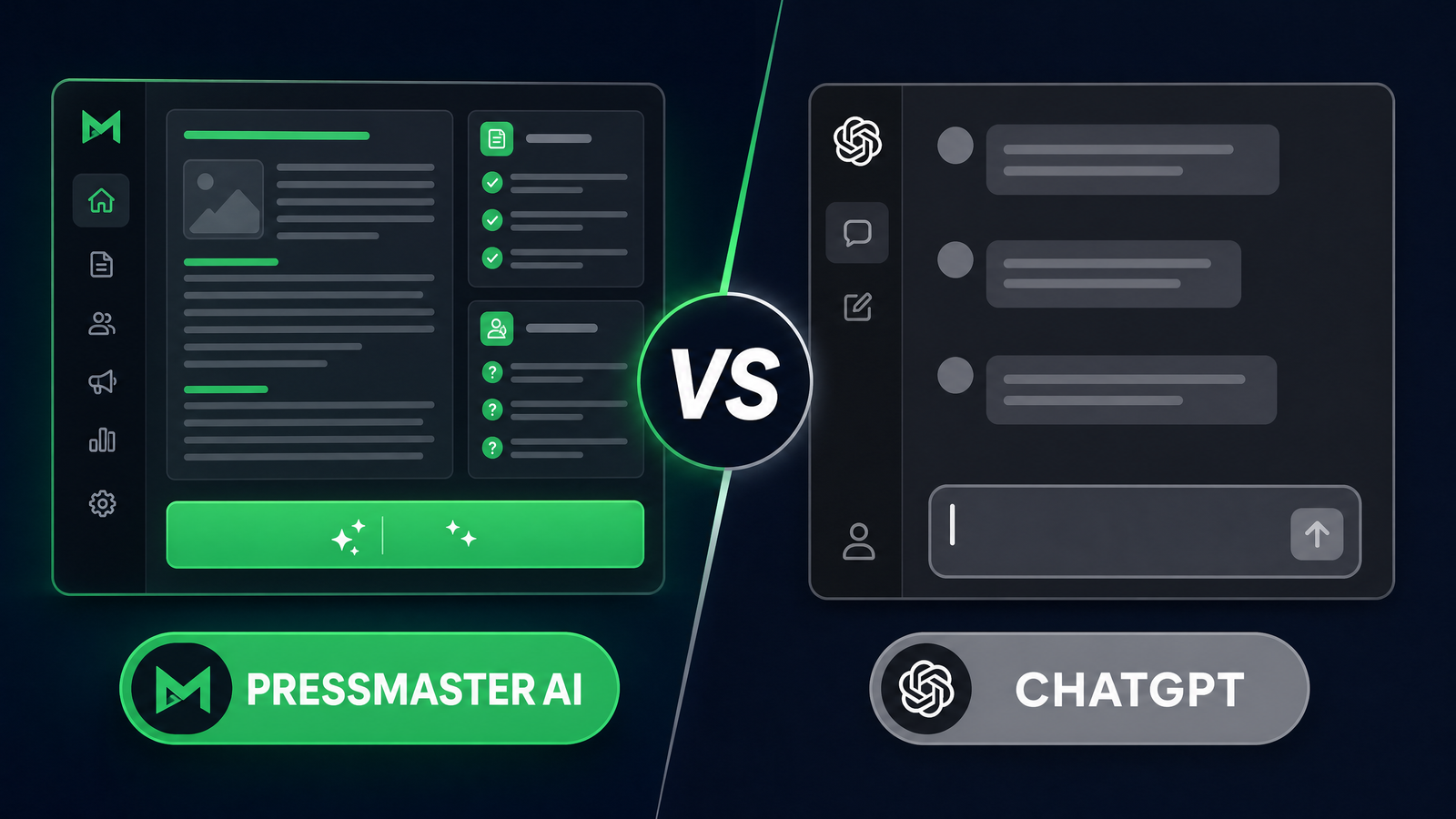
Quick Answer: Pressmaster AI and ChatGPT are both AI writing tools, but they solve completely different problems. ChatGPT is a general-purpose language model — you can use it for anything, but it has no press release structure, no brand voice memory, no distribution workflow, and no journalist-style interview process. Pressmaster AI is purpose-built for PR content: it interviews you, writes in your voice, formats for wire distribution, and auto-generates social content from the same source. If you need one press release, ChatGPT might work. If you need a consistent PR content engine, Pressmaster AI is the better tool.
The “ChatGPT vs dedicated tool” debate comes up constantly in the AI space, and press release writing is one of the most common battlegrounds. On the surface, it seems like ChatGPT should win — it’s free (or $20/month for Plus), it can write anything, and most people already have an account. But after using both tools extensively for PR content, the comparison is more nuanced than it first appears.
This breakdown covers what each tool actually does for press release writing, where each one falls short, and which one makes more sense depending on your situation.
Stop Prompting. Start Publishing.
Pressmaster AI’s interview-first approach writes press releases, LinkedIn posts, and social content in your voice — no prompt engineering required.
The Core Difference: General vs. Purpose-Built
ChatGPT is a general-purpose language model. It can write press releases, but it approaches them the same way it approaches everything else — you give it a prompt, it generates text. The quality of the output depends almost entirely on the quality of your prompt. If you know how to write a detailed, structured prompt with the right context, tone instructions, AP style guidelines, and distribution requirements, ChatGPT can produce a serviceable press release. If you don’t, you’ll get something that reads like a template.
Pressmaster AI takes the opposite approach. Instead of asking you to prompt it, it interviews you. The platform asks structured questions about your announcement, your company, your target audience, and your key messages — and then builds the press release from your answers. The result is content that sounds like you wrote it, not like a language model filled in a template.
Head-to-Head Comparison
| Feature | Pressmaster AI | ChatGPT (Plus) |
|---|---|---|
| Press release structure | ✅ Built-in AP style templates | ⚠️ Requires detailed prompting |
| Interview-based input | ✅ AI journalist interview flow | ❌ Prompt-only |
| Brand voice memory | ✅ Learns your tone over time | ❌ No memory between sessions |
| Social content generation | ✅ Auto-generates 15+ platform formats | ⚠️ Requires separate prompts per platform |
| Trend monitoring | ✅ Trendmaster feature (news angles) | ⚠️ Web browsing (Plus only, inconsistent) |
| Wire distribution readiness | ✅ Formatted for AP/EIN submission | ❌ Manual formatting required |
| Pricing | $21.75/month (annual Starter) | Free / $20/month (Plus) |
| PR-specific workflow | ✅ End-to-end PR content system | ❌ General writing tool only |
| Free trial | ✅ Yes, no credit card required | ✅ Free tier available |
Where ChatGPT Falls Short for Press Releases
The biggest limitation of using ChatGPT for press releases is that it has no context about your company, your previous announcements, your brand voice, or your target media. Every session starts from zero. If you want ChatGPT to write a press release that sounds like your company wrote it — not like a generic AI output — you need to provide all of that context in the prompt, every single time. That means writing a detailed briefing document, pasting in brand guidelines, specifying tone, listing boilerplate language, and explaining the announcement in full before the model can even start writing.
For a one-off press release, that overhead might be acceptable. For a team that needs to produce PR content consistently — product launches, executive commentary, partnership announcements, thought leadership pieces — the prompt-engineering tax adds up quickly. A marketing manager spending 45 minutes crafting a ChatGPT prompt is not saving time compared to a dedicated tool that already knows the workflow.
There’s also a structural problem. Press releases have specific formatting requirements: dateline, headline, subheadline, lead paragraph with the five Ws, body paragraphs in inverted pyramid order, boilerplate, contact information. ChatGPT knows these conventions, but it doesn’t enforce them reliably without explicit instructions. Pressmaster AI builds them in by default — the output arrives pre-formatted for wire submission.
Where ChatGPT Has a Real Advantage
ChatGPT’s advantage is flexibility. If you need to write something that doesn’t fit a standard press release format — a CEO op-ed, a crisis communications statement, a media pitch email, a product description — ChatGPT handles all of it without switching tools. Pressmaster AI is optimized for a specific content type; ChatGPT is a general-purpose writing environment.
ChatGPT is also genuinely useful for press release editing and iteration. If you’ve already written a draft — or if Pressmaster AI has produced one — you can paste it into ChatGPT and ask for a tighter headline, a stronger lead paragraph, or a different tone. Using both tools together is a legitimate workflow: Pressmaster AI for the structured first draft, ChatGPT for refinement and variation.
The free tier is also a real advantage for individuals or early-stage startups who need occasional PR content and can’t justify a monthly subscription. If you’re publishing one press release per quarter, ChatGPT Free with a well-crafted prompt might be sufficient.
The Prompt Engineering Problem
One thing that rarely gets discussed honestly in these comparisons: most people are not good at writing ChatGPT prompts for professional content. The gap between a mediocre ChatGPT press release and a good one is almost entirely determined by prompt quality — and prompt quality is a skill that takes time to develop. Pressmaster AI removes this variable entirely. The interview process is the prompt, and it’s been designed by people who understand what information a press release actually needs.
This is not a criticism of ChatGPT — it’s a design philosophy difference. ChatGPT gives you maximum flexibility at the cost of requiring expertise. Pressmaster AI gives you a constrained, optimized workflow at the cost of flexibility. For press release writing specifically, the constrained workflow wins for most users.
Real-World Use Case: Product Launch Announcement
Consider a SaaS founder announcing a new feature to their existing customer base and to tech media. Here’s what the workflow looks like with each tool:
With ChatGPT: The founder opens a new chat, writes a 300-word prompt explaining the company background, the new feature, the target audience, the tone they want, and the AP style requirements. ChatGPT produces a draft. The founder iterates 3–4 times to get the headline right, tighten the lead, and add the boilerplate. Total time: 45–60 minutes. Output: one press release. Social content requires a separate session.
With Pressmaster AI: The founder answers the AI journalist interview questions (10–15 minutes). Pressmaster AI generates the press release, a LinkedIn article, an X thread, Instagram captions, and Facebook post — all from the same interview session. The press release arrives pre-formatted for wire submission. Total time: 15–20 minutes. Output: one press release + 15+ social assets.
The time difference compounds significantly at scale. A team publishing 4 press releases per month saves 3–4 hours per month by using Pressmaster AI instead of ChatGPT — time that’s worth far more than the $21.75/month subscription cost.
Pricing Reality Check
ChatGPT Free is genuinely free, but it comes with rate limits, no memory, and no access to the latest model during high-traffic periods. ChatGPT Plus at $20/month gives you GPT-4o access, web browsing, and higher rate limits — but it’s still a general-purpose tool with no PR-specific features.
Pressmaster AI Starter at $21.75/month (billed annually) is nearly identical in price to ChatGPT Plus, but it includes the full PR content workflow, brand voice memory, the Trendmaster news monitoring feature, the Social Suite for multi-platform content, and wire-ready press release formatting. For anyone whose primary use case is PR content, the $1.75/month price difference is not a real consideration — the question is whether you need a general writing tool or a PR content engine.
Same Price as ChatGPT Plus. Built Specifically for PR.
Pressmaster AI Starter is $21.75/month — and it includes brand voice memory, the AI journalist interview, Social Suite for 15+ platforms, and wire-ready press release formatting. Free trial, no credit card required.
Who Should Use ChatGPT for Press Releases
ChatGPT makes sense for press release writing in three specific situations. First, if you only need one or two press releases per year and don’t want a recurring subscription. Second, if you’re already a skilled prompt engineer and can consistently produce high-quality PR content with a well-crafted system prompt. Third, if you need press release writing as one small part of a broader content workflow that also includes blog posts, email copy, product descriptions, and other content types where ChatGPT’s flexibility is genuinely valuable.
Who Should Use Pressmaster AI
Pressmaster AI makes sense for anyone who needs consistent, high-quality PR content without the prompt engineering overhead. This includes founders and executives who want to maintain a thought leadership presence without hiring a PR agency, marketing teams that need to produce press releases and social content at volume, and agencies managing PR content for multiple clients. The Pressmaster AI pricing structure — starting at $21.75/month for Starter, $44.25/month for Pro, and $72/month for Leader — scales with usage volume, making it viable for both individual users and larger teams.
For a deeper look at how Pressmaster AI compares to other dedicated PR tools, see our comparisons with Prowly, PRWeb, and EIN Presswire.
The Verdict
ChatGPT is a powerful general-purpose writing tool that can produce press releases. Pressmaster AI is a purpose-built PR content platform that happens to use AI. These are not the same thing, and the comparison only makes sense if you’re deciding which one to use for a specific use case.
For press release writing specifically, Pressmaster AI wins on structure, speed, brand consistency, and multi-platform output. ChatGPT wins on flexibility, cost (if using the free tier), and breadth of use cases beyond PR. If your primary need is PR content, the choice is straightforward. If you need a general writing assistant that can occasionally produce a press release, ChatGPT is the better fit.
Ready to Replace Your PR Workflow?
Pressmaster AI’s free trial lets you run the full interview-to-press-release workflow before you pay a dollar. See the difference yourself.
Frequently Asked Questions
Can ChatGPT write a press release?
Yes, ChatGPT can write press releases. The quality depends heavily on prompt quality — a detailed, well-structured prompt will produce a better result than a vague one. For occasional use, ChatGPT is a viable option. For consistent, volume PR content, a dedicated tool like Pressmaster AI is more efficient.
Is Pressmaster AI better than ChatGPT for PR?
For press release writing specifically, yes. Pressmaster AI has built-in AP style formatting, an AI journalist interview process, brand voice memory, and automatic social content generation — none of which ChatGPT offers natively. The price difference is minimal ($21.75/month vs $20/month for ChatGPT Plus).
Can I use ChatGPT and Pressmaster AI together?
Yes, and many PR professionals do. A common workflow is to use Pressmaster AI for the structured first draft and the social content, then use ChatGPT for headline variations, tone adjustments, or adapting the content for specific media outlets.
Does Pressmaster AI use ChatGPT under the hood?
Pressmaster AI is a purpose-built PR platform with its own AI models and workflow architecture. It is not simply a ChatGPT wrapper — the interview process, brand voice memory, and multi-platform content generation are proprietary features built specifically for PR content production.
What is the best free AI tool for writing press releases?
ChatGPT Free is the most capable free option for press release writing, though it requires strong prompting skills. Pressmaster AI offers a free trial that lets you test the full workflow before committing to a paid plan.